When and How to Introduce Solids to Your Baby: A Complete Guide
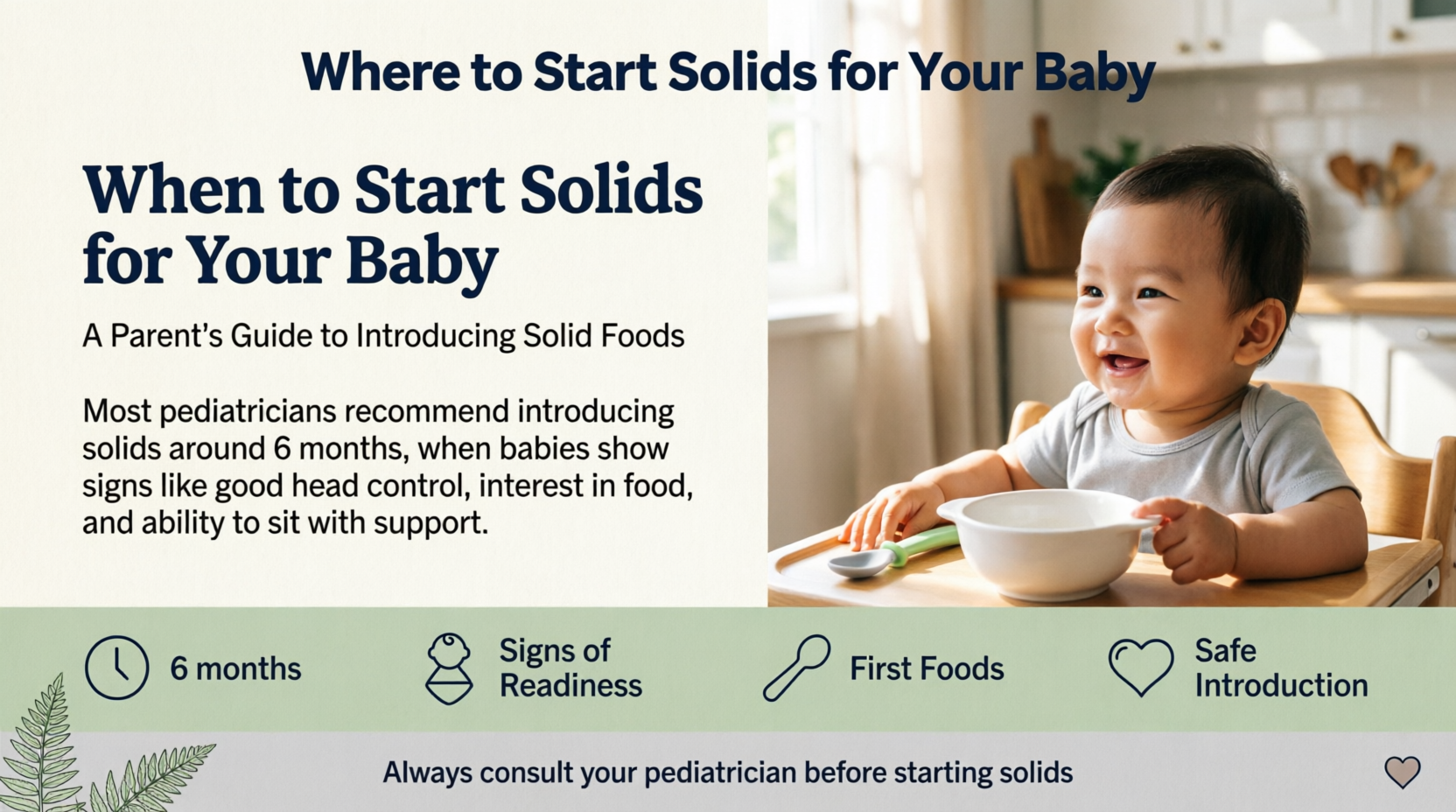
Most babies are ready for solids around 6 months, once they show clear signs of readiness — not before.
Key Takeaways
- Start solids at 6 months (180 days) of age, not earlier, while continuing breast milk or formula.
- Look for three readiness signs together — good head and neck control, the ability to sit with support, and loss of the tongue-thrust reflex — not just interest in food.
- Prioritize iron-rich foods early: a baby's natural iron stores begin to decline around 6 months.
- Feed 2–3 times a day at 6–8 months, increasing to 3–4 meals plus 1–2 snacks by 9–12 months, alongside continued breastfeeding.
- Introduce one new food at a time and wait 2–3 days before the next, watching for any reaction.
- Avoid added salt, added sugar, honey, and cow's milk as a main drink until after 12 months.
Starting solids is one of the most-asked questions in my clinic, and getting the timing and approach right matters for your baby's growth, iron levels, and long-term eating habits. This guide walks through when to start, the exact signs of readiness, a step-by-step approach to introducing food, a feeding schedule by age based on WHO and Indian Academy of Pediatrics (IAP) guidance, and the red flags that need medical attention.
Why 6 Months Is the Right Time to Start
The World Health Organization recommends exclusive breastfeeding for the first 6 months, with complementary foods introduced at 6 months (180 days) while breastfeeding continues up to 2 years or beyond. By around 6 months, a baby's digestive system, kidneys, and neuromuscular coordination for swallowing have matured enough to handle food beyond milk, and breast milk alone can no longer meet all of a growing baby's energy and iron needs.
Starting significantly earlier than 6 months increases the risk of choking, allergic reactions, and gut irritation, since digestion and swallowing coordination aren't fully ready. Starting significantly later than 6–7 months increases the risk of iron-deficiency anemia, growth faltering, and a baby becoming a more resistant eater when new textures are introduced too late.
Signs Your Baby Is Ready for Solids
Age alone isn't the only guide — look for these signs together, usually all present by 6 months:
- Good head and neck control — your baby can hold their head steady without support.
- Can sit with support — in a high chair or on your lap, with a fairly straight back.
- Loss of the tongue-thrust reflex — food placed on the tongue is swallowed rather than automatically pushed back out.
- Shows interest in food — watching you eat, reaching for food, opening the mouth as a spoon approaches.
- Can move food to the back of the mouth and swallow, rather than only sucking.
Interest in food alone, without the other signs, is not enough to start early — this is one of the most common reasons parents begin solids before 6 months.
How to Introduce Solids: A Step-by-Step Approach
- Start with a single-ingredient, iron-rich food — a smooth ragi or rice porridge, moong dal water progressing to mashed dal, or a well-cooked, mashed pulse — once or twice a day.
- Offer 2–3 teaspoons at first, before or after a milk feed, and let your baby's appetite guide the amount — don't force a fixed quantity.
- Introduce one new food at a time, waiting 2–3 days before adding the next, so any reaction is easy to trace.
- Progress texture gradually — smooth purees at 6 months, to mashed food with soft lumps by 8–9 months, to finely chopped finger foods by 9–12 months.
- Add vegetables, fruits, and more protein sources over the following weeks — mashed vegetables, ripe banana or papaya, egg yolk, well-cooked minced chicken or fish, and paneer.
- Keep breastfeeding or formula feeding on demand throughout — solids complement milk feeds in the first year, they don't replace them.
- Practice responsive feeding — follow your baby's hunger and fullness cues rather than insisting on finishing a bowl; forcing food is linked to poorer eating habits later, not better growth.
How Much and How Often: A Feeding Schedule by Age
| Age | Texture | Meals per Day | Approx. Portion per Meal |
|---|---|---|---|
| 6–8 months | Smooth purees, mashed, soft porridge | 2–3 meals + breastfeeding on demand | 2–3 teaspoons, building up to half a cup |
| 9–11 months | Mashed with soft lumps, finely chopped, soft finger foods | 3–4 meals + 1–2 snacks + breastfeeding | About half a cup per meal |
| 12–23 months | Chopped family food, most textures | 3–4 meals + 1–2 snacks + continued breastfeeding | Around ¾ to 1 cup per meal |
Babies who are not breastfed generally need one extra feed a day at each stage, since they lose the flexible, on-demand feeds that breastfeeding provides.
Good First Foods for Indian Babies
Home-prepared, family-staple foods work well as first foods and don't need to be store-bought:
- Iron-rich foods (prioritize these early): ragi porridge, fortified cereal, moong or masoor dal, well-cooked minced chicken or fish, egg yolk, leafy green vegetables mashed fine
- Cereals and grains: rice, wheat (as soft chapati soaked in milk or dal and sieved), oats, ragi
- Vegetables: mashed carrot, pumpkin, potato, sweet potato, bottle gourd
- Fruits: ripe banana, apple (cooked and mashed), papaya, mango in season
- Other protein sources: paneer, curd/yogurt (from 6 months, pasteurized), whole dal once tolerated
Most children can tolerate the moderate amount of spices used in typical home cooking (turmeric, cumin, coriander) — this doesn't need to be avoided, though chili and heavy spice should still wait.
Introducing Allergenic Foods Safely
Current guidance no longer supports delaying common allergenic foods. There is no evidence that delaying egg, peanut, dairy, or fish prevents food allergy — in fact, early, regular introduction (from around 6 months) is now linked to a lower risk of developing an allergy to that food.
- Introduce egg, peanut (as smooth peanut butter thinned into porridge or yogurt, never whole nuts), fish, and dairy from around 6 months, alongside other first foods.
- Offer a small amount first, then continue the food regularly if tolerated — occasional exposure is less protective than routine inclusion.
- If your baby has severe eczema or a known food allergy, talk to your pediatrician before introducing highly allergenic foods, since these babies need a more supervised approach.
- Never give whole peanuts, whole nuts, or peanut chunks to an infant or toddler — these are choking hazards regardless of allergy status.
Foods and Practices to Avoid in the First Year
- Honey — risk of infant botulism before 12 months.
- Cow's milk as a main drink — before 12 months; small amounts in cooking are fine after 6 months.
- Added salt and added sugar — a baby's kidneys can't process much sodium, and early sugar builds a preference away from nutrient-dense foods.
- Choking hazards — whole nuts, whole grapes, raw hard vegetables, popcorn, and hard candy.
- Unpasteurized milk or dairy products.
- Follow-up/toddler formulas marketed for this age — not recommended over age-appropriate food and continued breast milk or regular animal milk.
Home Care vs. When to See a Doctor
Continue as usual when:
- Your baby tries a new food and has mild, brief fussiness or a slightly different stool consistency
- Solids are accepted inconsistently in the first 2–3 weeks — this is normal as babies learn a new skill
- Your baby is gaining weight steadily and remains active and alert
See a doctor if:
- Your baby consistently refuses all solids past 7–8 months
- There's persistent vomiting, blood in the stool, or ongoing diarrhea after starting a new food
- Weight gain slows or stalls after solids are introduced
- You're unsure whether your baby, given eczema or a family history of allergy, is ready for a specific allergenic food
When to Seek Emergency Care
Most babies transition to solids without complications, but a few situations need immediate attention. As a Pediatric Intensivist, these are the ones I want every parent to recognize instantly:
- Choking — unable to cry, cough, or breathe after swallowing food; bluish lips or face — call for emergency help and begin infant choking first-aid immediately.
- Signs of a severe allergic reaction (anaphylaxis) — facial or lip swelling, widespread hives, repeated vomiting, difficulty breathing, or sudden lethargy within minutes to two hours of a new food — go to an emergency department right away.
- Blood in vomit or stool after a new food.
- Signs of dehydration after vomiting or diarrhea — noticeably fewer wet diapers, a sunken soft spot, or unusual lethargy.
- Persistent refusal to feed combined with weight loss or lethargy.
A baby who develops breathing difficulty, repeated vomiting, or signs of shock after a food reaction may need hospital admission for monitoring and, in severe cases, PICU-level care to stabilize them safely.
Common feeding myths worth unlearning
Delaying solids past 6–7 months doesn't protect a baby — it raises the risk of iron-deficiency anemia and slower growth. Feeding only thin rice water or diluted porridge without any dal, egg, or minced meat leaves out the iron and protein a growing baby needs, even if the stomach looks "full." Avoiding non-vegetarian food or eggs for years isn't necessary on medical grounds and delays access to some of the most iron- and protein-dense first foods. And a baby who eats less at one meal isn't refusing out of stubbornness — appetite naturally varies day to day, and forcing food tends to backfire rather than help.
Every baby's pace with solids is a little different, and that's normal. If feeding isn't progressing the way you'd expect, or you'd like a personalized plan for your baby's readiness and growth, Dr Suchit Jogu at KIMS Cuddles, Kompally, is available to guide you through it.
FAQs
What is the right age to start giving my baby solid foods?
6 months (180 days) of age, while continuing breast milk or formula. Starting earlier than 6 months is not recommended for a healthy, term baby.
My 4-month-old watches me eat and reaches for food — can I start solids early?
No. Interest in food is only one readiness sign, and it commonly appears before a baby's gut, kidneys, and swallowing coordination are actually ready. Wait until 6 months unless your pediatrician advises otherwise.
Should I start with rice cereal or vegetables first?
There's no mandatory first food. Prioritize iron-rich foods early — ragi, fortified cereal, dal, or well-cooked minced meat or egg yolk — since a baby's iron stores begin to run low around 6 months.
How do I know if my baby is reacting to a new food?
Introduce one new food at a time and wait 2–3 days before the next. Watch for rash, vomiting, loose stools, or unusual fussiness. Facial swelling, hives, or breathing difficulty needs emergency care immediately.
Can I give my baby cow's milk to drink?
Not as a main drink before 12 months. Small amounts used in cooking are fine after 6 months, but breast milk or formula should remain the primary drink until age 1.
Is it okay to add salt or sugar to my baby's food?
Avoid added salt and sugar in the first year — a baby's kidneys can't handle much sodium, and early sugar builds a preference for sweet foods.
My baby refuses solids and only wants to breastfeed — what should I do?
This is common in the first few weeks. Keep offering food without pressure once or twice a day; breast milk remains primary nutrition until 12 months. If refusal continues for weeks or weight gain slows, talk to your pediatrician.
When can I introduce egg and peanut to my baby?
Around 6 months, alongside other first foods, in a soft or thinned form. If your baby has severe eczema or a known food allergy, discuss timing with your pediatrician first.
This article is for general educational purposes and is not a substitute for professional medical advice, diagnosis, or treatment. Always consult your child's pediatrician with questions about a specific medical condition.